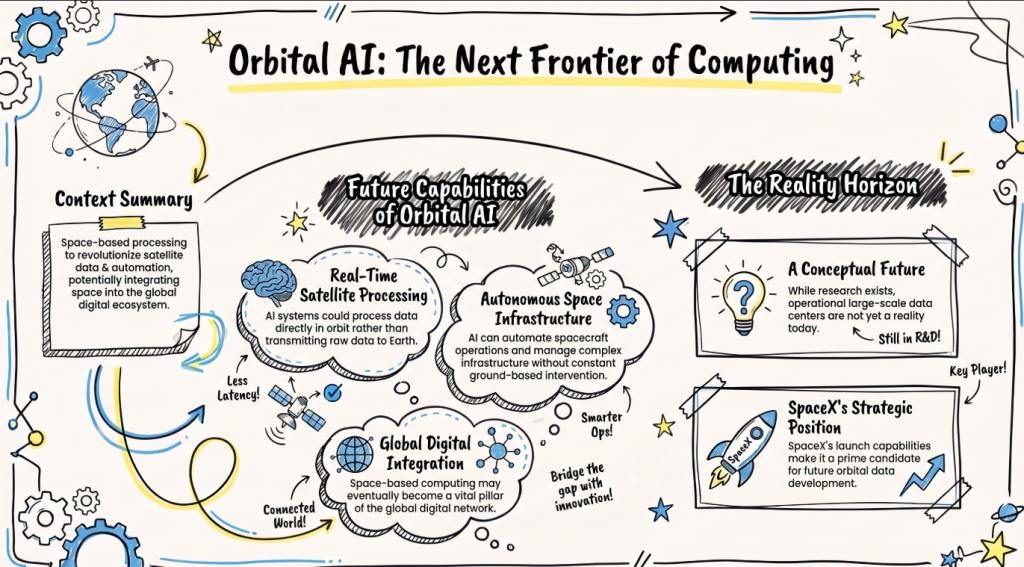
As artificial intelligence (AI), cloud computing, and big data continue to expand, the demand for powerful data centres is growing rapidly. Traditional data centres consume enormous amounts of electricity, require extensive cooling systems, and occupy large areas of land. These challenges have led researchers and technology companies to explore innovative alternatives including the possibility of placing data centres in space. One company often associated with ambitious space technology is SpaceX, which has transformed satellite communications, reusable rockets, and commercial spaceflight. Although SpaceX has not announced operational data centres in orbit, the idea of space-based computing is receiving increasing attention from the aerospace and technology industries.
Table of Contents
What Is a Data Centre?
A data centre is a facility that houses computer servers, networking equipment, storage systems, and security infrastructure. These facilities process, store, and distribute enormous amounts of digital information every second.
Data centres support services such as:
- Artificial Intelligence
- Cloud Computing
- Video Streaming
- Online Banking
- Social Media
- E-commerce
- Scientific Research
- Government Services
Without data centres, many of the digital services we use every day would not function.
Why Are Data Centres Important?
The rapid growth of AI, machine learning, cloud services, and Internet-connected devices has significantly increased global demand for computing power. Modern data centres require reliable electricity, advanced cooling systems, high-speed networking, and strong cybersecurity to operate efficiently.
As demand continues to rise, technology companies are searching for ways to make data centres more sustainable and energy efficient.
Learn more:
- SpaceX: https://www.spacex.com/
- NASA: https://www.nasa.gov/
- European Space Agency: https://www.esa.int/
Why Consider Data Centres in Orbit?
Building data centres in orbit could offer several theoretical advantages. In space, natural cooling conditions may reduce the need for traditional air-conditioning systems, and future facilities could potentially draw power from continuous sunlight using large solar arrays. Space-based computing could also support satellites, scientific missions, and future lunar or Mars exploration.
Researchers have proposed concepts where orbital computing platforms process data closer to satellites before sending only essential information back to Earth, reducing communication requirements.
However, these ideas remain largely experimental.
Could SpaceX Make This Possible?
SpaceX has developed reusable rockets, the Starlink satellite network, and the Starship launch system, making it one of the companies most capable of transporting large payloads into orbit. While SpaceX has not announced plans to build or operate orbital data centres, its launch capabilities could support future commercial or scientific projects if the technology becomes practical.
The company’s ability to reduce launch costs may make large-scale space infrastructure more achievable over time.
Advantages of Space-Based Data Centres
If orbital data centres become viable in the future, they could provide several potential benefits:
- Reduced land usage on Earth.
- Access to solar energy for extended periods.
- Lower dependence on conventional cooling systems.
- Support for space missions and satellite operations.
- Processing satellite data closer to its source.
- Opportunities for scientific research and innovation.
These possibilities continue to attract interest from researchers and technology companies.
Challenges That Must Be Solved
Despite their potential, orbital data centres face major engineering and economic challenges.
These include:
- High launch costs.
- Protecting equipment from radiation.
- Repairing hardware in space.
- Managing space debris.
- Reliable communication with Earth.
- Long-term maintenance.
- Environmental sustainability.
- International regulations governing space activities.
Solving these challenges will require advances in aerospace engineering, robotics, communications, and computing.
The Future of AI and Space Computing
Artificial intelligence is expected to play an important role in managing future space infrastructure. AI systems could monitor hardware health, optimise energy usage, detect faults, automate maintenance, and improve communication between Earth and orbiting systems.
As both AI and space technology continue to evolve, concepts such as orbital computing, autonomous satellites, and space-based cloud infrastructure may become increasingly realistic.
Frequently Asked Questions
Does SpaceX currently operate data centres in orbit?
No. As of today, SpaceX has not announced or deployed operational data centres in orbit.
Why would companies consider space-based data centres?
Potential reasons include improved access to solar energy, reduced cooling requirements, and supporting future satellite and space exploration missions.
Could AI benefit from orbital computing?
Potentially. Future AI systems could process satellite data in orbit, automate spacecraft operations, and manage complex space infrastructure.
Is this technology available today?
Not yet. While research and proposals exist, large-scale orbital data centres remain a future concept rather than an operational reality.
Final Thoughts
The idea of placing data centres in orbit represents one of the most ambitious visions for the future of computing. Although SpaceX has not announced plans to build orbital data centres, its launch capabilities and experience with large-scale space infrastructure position it as a company that could contribute to such developments in the future. As artificial intelligence, cloud computing, and space exploration continue to advance, space-based computing may one day become an important part of the global digital ecosystem.
Learn with preEminent Academy
Interested in the technologies shaping the future? At preEminent Academy, we offer industry-recognised courses in Artificial Intelligence, Data Science, Cloud Computing, Networking, Linux, Cybersecurity, and Programming through our partnership with Cisco Networking Academy.
Website: https://www.preeminent.co.za/
Explore Our Tech Courses: https://www.preeminent.co.za/tech-courses/
Follow us on Instagram: https://www.instagram.com/preeminent_academy/