Data has become one of the most valuable assets in today’s digital economy, and businesses across South Africa are searching for professionals who can transform raw data into meaningful insights. From banks and insurance companies to retailers, healthcare providers, telecommunications firms, and government departments, organisations rely on Data Analysts to help them make informed decisions that improve performance and drive growth.
If you enjoy working with numbers, solving problems, identifying trends, and using technology to answer business questions, a career as a Data Analyst could be the perfect fit. It is one of the fastest-growing careers in South Africa and offers excellent opportunities for career progression into Business Intelligence, Data Science, Artificial Intelligence, and Data Engineering.
At preEminent Academy, we help learners build practical, job-ready skills through industry-recognised technology courses in SQL, Microsoft Power BI, Python, Artificial Intelligence, Data Science, Linux, and Cisco Networking Academy programmes.
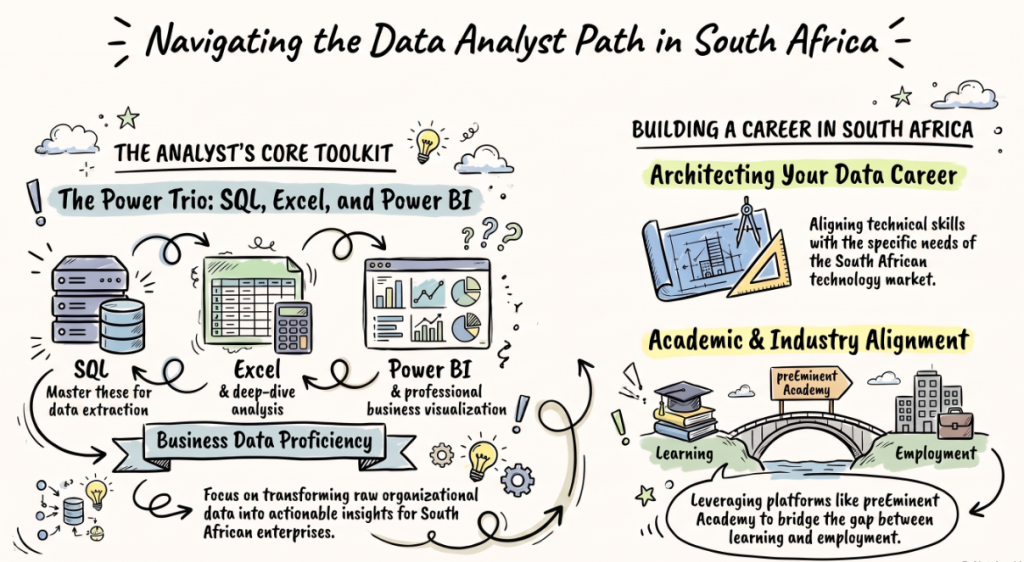
Table of Contents
What Is a Data Analyst?
A Data Analyst collects, cleans, analyses, and interprets data to help organisations make better business decisions. Instead of simply looking at numbers, Data Analysts identify patterns, trends, and opportunities that enable businesses to improve operations, increase profits, reduce costs, and enhance customer experiences.
A Data Analyst works with large datasets using tools such as Microsoft Excel, SQL, Power BI, Python, and cloud-based analytics platforms. They create reports, dashboards, and visualisations that allow managers and executives to understand business performance quickly and accurately.
Data Analysts play a vital role in industries such as finance, healthcare, retail, telecommunications, logistics, education, and government.
What Does a Data Analyst Do?
A typical day as a Data Analyst may include:
- Collecting data from different systems.
- Cleaning inaccurate or incomplete data.
- Writing SQL queries to retrieve information.
- Analysing business trends.
- Creating dashboards and reports.
- Building visualisations in Power BI.
- Presenting findings to stakeholders.
- Supporting business decision-making.
- Identifying opportunities for improvement.
- Automating reports and processes.
Their work helps organisations make evidence-based decisions instead of relying on assumptions.
Why Choose Data Analytics in South Africa?
South African businesses are investing heavily in digital transformation and data-driven decision-making. Companies are looking for professionals who can analyse business performance, improve efficiency, and uncover valuable insights from data.
Data Analysts are in demand across many sectors, including:
- Banking
- Insurance
- Retail
- Healthcare
- Telecommunications
- Mining
- Logistics
- Government
- Manufacturing
- E-commerce
Because data is used in almost every industry, Data Analysts have a wide range of career opportunities.
10 Steps to Become a Data Analyst
1. Develop Strong Mathematics and Analytical Skills
A strong foundation in Mathematics and logical thinking is useful for analysing data and solving business problems. Subjects such as Mathematics, Statistics, and Computer Applications Technology can provide a great starting point.
2. Learn Microsoft Excel
Excel remains one of the most widely used business tools. Every Data Analyst should know how to:
- Create formulas and functions.
- Use Pivot Tables.
- Create charts and graphs.
- Clean datasets.
- Perform data analysis.
- Build reports.
Learn Excel:
3. Master SQL
SQL (Structured Query Language) is one of the most important skills for Data Analysts because it allows you to retrieve, filter, and analyse data stored in databases.
Essential SQL skills include:
- SELECT statements
- WHERE clauses
- JOINs
- GROUP BY
- Window functions
- Common Table Expressions (CTEs)
- Views
- Stored procedures
Learn SQL:
- Microsoft Learn: https://learn.microsoft.com/sql/
- PostgreSQL: https://www.postgresql.org/
4. Learn Microsoft Power BI
Power BI is one of the world’s leading Business Intelligence tools. It enables Data Analysts to create interactive dashboards and visual reports.
You’ll learn how to:
- Connect to multiple data sources.
- Build dashboards.
- Create KPIs.
- Write DAX formulas.
- Develop business reports.
- Share insights with stakeholders.
Learn Power BI:
5. Learn Python
Python helps automate repetitive tasks, analyse large datasets, and perform advanced analytics.
Popular libraries include:
- Pandas
- NumPy
- Matplotlib
- Seaborn
- Scikit-learn
Python also provides a pathway into Data Science and Artificial Intelligence.
Learn Python:
6. Understand Statistics
Statistics helps Data Analysts interpret data accurately.
Important topics include:
- Mean, median, and mode.
- Standard deviation.
- Correlation.
- Probability.
- Regression.
- Hypothesis testing.
A good understanding of statistics improves your ability to explain business trends.
7. Build Real Projects
Employers want to see practical experience.
Create projects such as:
- Sales dashboards.
- Customer analysis reports.
- Financial performance dashboards.
- HR analytics.
- Retail data analysis.
- Marketing campaign reports.
Upload your projects to GitHub or create a professional portfolio.
8. Learn Data Visualisation
A Data Analyst must communicate findings clearly.
Good visualisations help stakeholders understand:
- Trends
- Patterns
- Risks
- Opportunities
- Business performance
Tools include:
- Power BI
- Tableau
- Excel
- Looker Studio
9. Earn Professional Certifications
Industry-recognised certifications help strengthen your CV.
Recommended certifications include:
- Microsoft Certified: Power BI Data Analyst Associate
- Microsoft Azure Fundamentals
- Google Data Analytics Professional Certificate
- IBM Data Analyst Professional Certificate
- Cisco Networking Academy Data Science courses
10. Apply for Entry-Level Roles
Once you’ve developed your skills, begin applying for positions such as:
- Junior Data Analyst
- Reporting Analyst
- Business Intelligence Analyst
- Operations Analyst
- Data Quality Analyst
- Insights Analyst
- Junior Business Analyst
Practical projects and certifications can significantly improve your chances of securing your first role.
Essential Technical Skills
Successful Data Analysts usually possess:
- SQL
- Microsoft Excel
- Power BI
- Python
- Statistics
- Data Cleaning
- Data Visualisation
- Problem Solving
- Business Analysis
- Communication Skills
- Critical Thinking
- Presentation Skills
Data Analyst Tools You Should Learn
Modern Data Analysts frequently use:
- Microsoft Excel
- Microsoft Power BI
- SQL Server
- PostgreSQL
- MySQL
- Python
- Jupyter Notebook
- Microsoft Fabric
- Tableau
- GitHub
Learning these tools will make you more competitive in the South African job market.
Career Path for Data Analysts
A typical career progression may look like:
- Junior Data Analyst
- Data Analyst
- Senior Data Analyst
- Business Intelligence Analyst
- Analytics Consultant
- Data Scientist
- Analytics Manager
- Head of Analytics
- Chief Data Officer
Many professionals later transition into Data Engineering, Artificial Intelligence, or Machine Learning careers.
Data Analyst Salary in South Africa
Data Analytics offers competitive salaries depending on experience, qualifications, industry, and technical skills.
Typical salary ranges include:
| Experience | Estimated Annual Salary |
|---|---|
| Junior Data Analyst | R250,000 – R450,000 |
| Mid-Level Data Analyst | R450,000 – R700,000 |
| Senior Data Analyst | R700,000 – R1,100,000 |
| Analytics Manager | R1,000,000+ |
These figures are estimates and can vary by employer, location, and experience.
Frequently Asked Questions
Do I need a university degree to become a Data Analyst?
A degree in Statistics, Mathematics, Computer Science, Information Systems, Economics, or a related field can be beneficial. However, many employers also consider candidates with practical skills, certifications, and strong project portfolios.
Is SQL the most important skill?
Yes. SQL is one of the most requested skills for Data Analyst positions because most business data is stored in relational databases.
Should I learn Power BI or Tableau?
Both are valuable. Power BI is widely used across South African organisations, while Tableau is also popular in many industries. Learning either tool will improve your employability.
Can I become a Data Analyst without experience?
Yes. Build practical projects, complete certifications, develop a portfolio, and apply for internships or junior roles to gain experience.
Further Reading
Expand your knowledge with these trusted resources:
- Microsoft Learn: https://learn.microsoft.com/
- Microsoft Power BI: https://learn.microsoft.com/power-bi/
- Python Documentation: https://docs.python.org/
- PostgreSQL: https://www.postgresql.org/
- Kaggle: https://www.kaggle.com/
- GitHub: https://github.com/
Final Thoughts
Data Analytics is one of the most exciting and rewarding careers in South Africa’s growing digital economy. Organisations across every industry need professionals who can collect, analyse, and interpret data to support smarter business decisions.
By learning SQL, Microsoft Excel, Power BI, Python, statistics, and data visualisation, you’ll build a strong foundation for a successful career as a Data Analyst. Continuous learning, practical projects, and professional certifications will help you stand out in a competitive job market and create opportunities for advancement into Business Intelligence, Data Science, and Artificial Intelligence.
Learn with preEminent Academy
Take the first step towards your career in Data Analytics with preEminent Academy. We offer career-focused technology training in Data Analytics, SQL, Microsoft Power BI, Python, Artificial Intelligence, Linux, Networking, Cybersecurity, and Data Science, helping you develop practical skills that employers value.
Website: https://www.preeminent.co.za/
Explore Our Tech Courses: https://www.preeminent.co.za/tech-courses/
Follow us on Instagram: https://www.instagram.com/preeminent_academy/