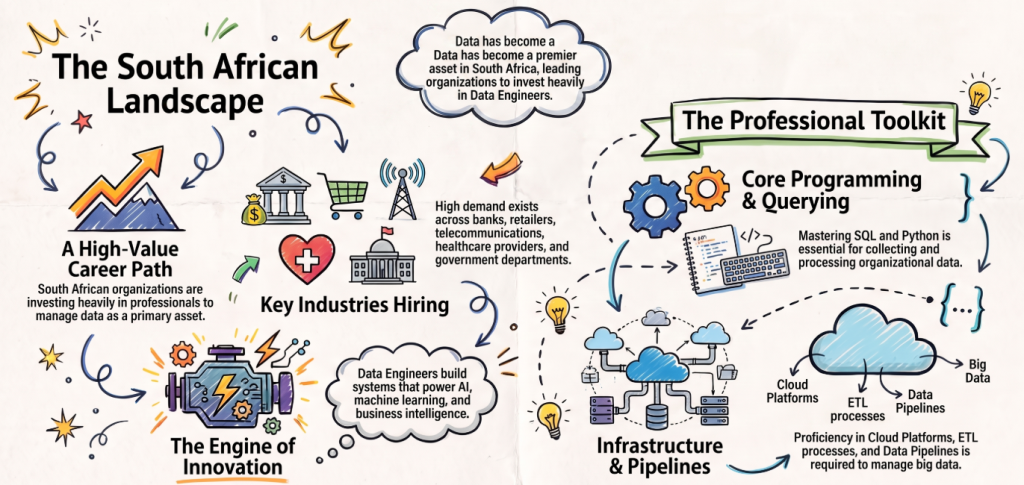
Data has become one of the world’s most valuable assets, and organisations across South Africa are investing heavily in professionals who can collect, process, store, and manage it efficiently. From banks and retailers to telecommunications companies, healthcare providers, and government departments, businesses rely on Data Engineers to build the systems that power analytics, artificial intelligence (AI), machine learning, and business intelligence.
If you’re interested in technology, problem-solving, databases, and programming, a career in Data Engineering could be an excellent choice. It is one of the fastest-growing technology careers globally and offers competitive salaries, strong career progression, and opportunities to work with cutting-edge cloud technologies.
At preEminent Academy, we help learners prepare for careers in data and technology through practical, industry-recognised training in Python, SQL, Linux, Artificial Intelligence, Data Science, and Cisco Networking Academy programmes.
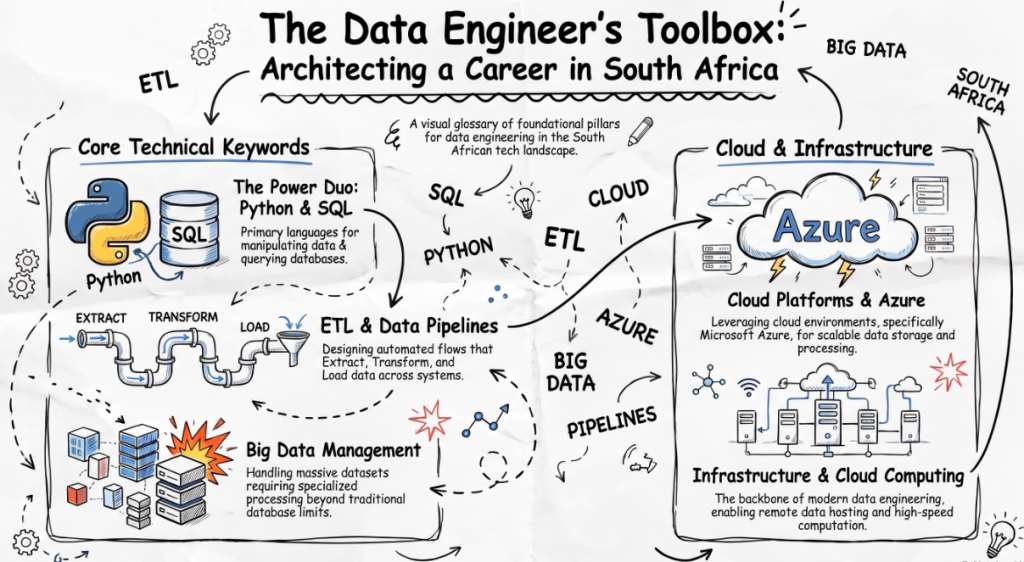
Table of Contents
What Is a Data Engineer?
A Data Engineer designs, builds, and maintains the systems that collect, process, transform, and store data. They create reliable data pipelines that move information from different sources into databases and cloud platforms where it can be analysed by Data Analysts, Business Intelligence Developers, and Data Scientists.
Unlike Data Scientists who focus on analysing data and building predictive models, Data Engineers build the infrastructure that makes this analysis possible.
Typical responsibilities include:
- Designing data pipelines.
- Building ETL (Extract, Transform, Load) processes.
- Managing databases.
- Working with cloud platforms.
- Optimising SQL queries.
- Automating data workflows.
- Ensuring data quality and reliability.
- Supporting analytics and reporting teams.
What Does a Data Engineer Do?
A typical day for a Data Engineer may involve:
- Extracting data from multiple systems.
- Cleaning and transforming raw data.
- Loading data into warehouses or lakes.
- Creating automated workflows.
- Monitoring pipeline performance.
- Optimising database queries.
- Troubleshooting data issues.
- Collaborating with software developers and data scientists.
- Securing sensitive business information.
- Building scalable cloud-based solutions.
Data Engineers are essential because organisations depend on accurate and reliable data to make informed business decisions.
Why Choose Data Engineering in South Africa?
South Africa’s digital economy continues to expand, creating demand for professionals with data engineering skills. Industries such as banking, insurance, telecommunications, retail, healthcare, mining, logistics, and e-commerce increasingly rely on large volumes of data.
Companies are actively recruiting professionals who understand:
- SQL
- Python
- Cloud Computing
- Data Warehousing
- ETL Development
- Big Data Technologies
- Database Administration
- Business Intelligence
Many employers also value practical experience and industry-recognised certifications alongside formal qualifications.
10 Steps to Become a Data Engineer
1. Build Strong Mathematics and Analytical Skills
Mathematics develops logical thinking and problem-solving abilities that are useful in programming, data modelling, optimisation, and analytics. Subjects such as Mathematics, Statistics, and Computer Applications Technology provide a solid foundation.
2. Learn SQL
SQL (Structured Query Language) is one of the most important skills for Data Engineers.
You should learn how to:
- Write SELECT queries.
- Join multiple tables.
- Use aggregate functions.
- Create stored procedures.
- Optimise query performance.
- Design relational databases.
- Work with indexes and views.
SQL remains one of the most requested skills in Data Engineering job advertisements.
Learn SQL:
- Microsoft Learn: https://learn.microsoft.com/sql/
- PostgreSQL: https://www.postgresql.org/
3. Learn Python
Python is widely used for automation, scripting, ETL development, data processing, and cloud applications.
Important Python libraries include:
- Pandas
- NumPy
- PySpark
- Requests
- SQLAlchemy
Python also provides an excellent foundation for Artificial Intelligence and Machine Learning.
Learn Python:
- Python.org: https://www.python.org/
- Python Documentation: https://docs.python.org/
4. Understand Databases
Data Engineers work with relational and non-relational databases.
Examples include:
- Microsoft SQL Server
- PostgreSQL
- MySQL
- Oracle Database
- MongoDB
Understanding database design, normalisation, indexing, and optimisation is essential.
5. Learn ETL and Data Pipelines
ETL stands for Extract, Transform, and Load. It is the process of collecting data from different sources, cleaning it, transforming it into useful formats, and loading it into a data warehouse.
Popular ETL tools include:
- SQL Server Integration Services (SSIS)
- Azure Data Factory
- Apache Airflow
- Talend
- Informatica
6. Learn Cloud Computing
Modern Data Engineers increasingly work in cloud environments.
Popular cloud platforms include:
- Microsoft Azure
- Amazon Web Services (AWS)
- Google Cloud Platform (GCP)
Cloud skills make candidates significantly more competitive in today’s job market.
Learn more:
- Microsoft Azure: https://azure.microsoft.com/
- AWS: https://aws.amazon.com/
- Google Cloud: https://cloud.google.com/
7. Learn Linux
Many enterprise data platforms run on Linux servers.
Basic Linux skills include:
- File management
- Shell commands
- User administration
- Process management
- Bash scripting
- File permissions
Linux knowledge is highly valuable for cloud and DevOps environments.
8. Learn Big Data Technologies
Large organisations often process millions of records daily.
Popular technologies include:
- Apache Spark
- Hadoop
- Kafka
- Databricks
- Snowflake
These tools help organisations process massive datasets efficiently.
9. Build Real Projects
Employers value practical experience.
Create projects such as:
- Sales dashboards
- ETL pipelines
- Data warehouses
- SQL portfolio projects
- Cloud data pipelines
- Python automation scripts
Publishing projects on GitHub demonstrates your technical ability to employers.
10. Earn Industry Certifications
Professional certifications strengthen your CV and demonstrate practical competence.
Recommended certifications include:
- Microsoft Azure Data Engineer Associate
- Microsoft Fabric Analytics Engineer Associate
- Microsoft Power BI Data Analyst Associate
- AWS Certified Data Engineer
- Google Professional Data Engineer
- Cisco Networking Academy Python and Linux courses
Essential Technical Skills
Successful Data Engineers typically possess:
- SQL
- Python
- Linux
- Cloud Computing
- ETL Development
- Database Design
- Data Warehousing
- Git
- Data Modelling
- API Integration
- Performance Optimisation
- Problem Solving
Programming Languages Every Data Engineer Should Learn
Although SQL and Python are the most important, learning additional languages can expand your opportunities.
Recommended languages include:
- SQL
- Python
- Bash
- Java
- Scala
- JavaScript (for some data applications)
Popular Data Engineering Tools
Some of the most widely used technologies include:
- Microsoft SQL Server
- PostgreSQL
- MySQL
- Azure Data Factory
- Microsoft Fabric
- Databricks
- Snowflake
- Apache Spark
- Apache Kafka
- Docker
- GitHub
- Power BI
Learning these tools can make you more competitive for Data Engineering roles.
Data Engineer Career Path
A typical career progression might look like this:
- Junior Data Engineer
- Data Engineer
- Senior Data Engineer
- Lead Data Engineer
- Data Architect
- Cloud Data Engineer
- Analytics Engineering Manager
- Head of Data Engineering
With experience, professionals may also move into cloud architecture, AI engineering, or technical leadership roles.
Data Engineer Salary in South Africa
Data Engineering is generally one of the better-paying technology careers in South Africa. Salaries vary depending on experience, industry, location, qualifications, and technical skills.
Typical ranges are:
| Experience | Estimated Annual Salary |
|---|---|
| Junior Data Engineer | R300,000 – R550,000 |
| Mid-Level Data Engineer | R550,000 – R900,000 |
| Senior Data Engineer | R900,000 – R1,400,000+ |
| Lead Data Engineer | R1,300,000+ |
These figures are indicative and may differ between employers and regions.
Frequently Asked Questions
Do I need a university degree to become a Data Engineer?
A degree in Computer Science, Information Systems, Mathematics, Engineering, or a related field can be helpful, but many employers also consider candidates with strong practical skills, relevant certifications, and an impressive portfolio.
Is SQL more important than Python?
Both are essential. SQL is fundamental for querying and managing data, while Python is widely used for automation, ETL, and data processing.
Is cloud computing important for Data Engineers?
Yes. Many organisations use cloud platforms such as Microsoft Azure, AWS, and Google Cloud to build modern data solutions.
Can I become a Data Engineer without experience?
Yes. Build personal projects, earn certifications, contribute to GitHub, and apply for internships or junior roles to gain practical experience.
Further Reading
Explore these trusted learning resources:
- Microsoft Learn: https://learn.microsoft.com/
- Azure Documentation: https://learn.microsoft.com/azure/
- Python Documentation: https://docs.python.org/
- PostgreSQL: https://www.postgresql.org/
- Apache Spark: https://spark.apache.org/
- GitHub: https://github.com/
Final Thoughts
Data Engineering is one of the most exciting and rewarding technology careers available today. As South African organisations continue investing in data-driven decision-making, professionals who can build reliable data pipelines, manage cloud platforms, optimise databases, and support analytics teams will remain in high demand.
Whether you’re a high school learner planning your future, a university student exploring career options, or a working professional looking to transition into technology, now is an excellent time to develop SQL, Python, Linux, cloud computing, and data engineering skills.
With dedication, continuous learning, practical projects, and industry-recognised certifications, you can build a successful and future-proof career as a Data Engineer in South Africa.
Learn with preEminent Academy
Prepare for a successful career in technology with preEminent Academy. We offer practical, career-focused training in Python, Linux, Artificial Intelligence, Data Science, Networking, Cybersecurity, and other industry-recognised programmes through Cisco Networking Academy.
Website: https://www.preeminent.co.za/
Explore Our Tech Courses: https://www.preeminent.co.za/tech-courses/
Follow us on Instagram: https://www.instagram.com/preeminent_academy/