Why does a soccer ball stop rolling after being kicked?
Why do passengers move forward when a car suddenly brakes?
Why is it harder to push a heavy object than a light one?
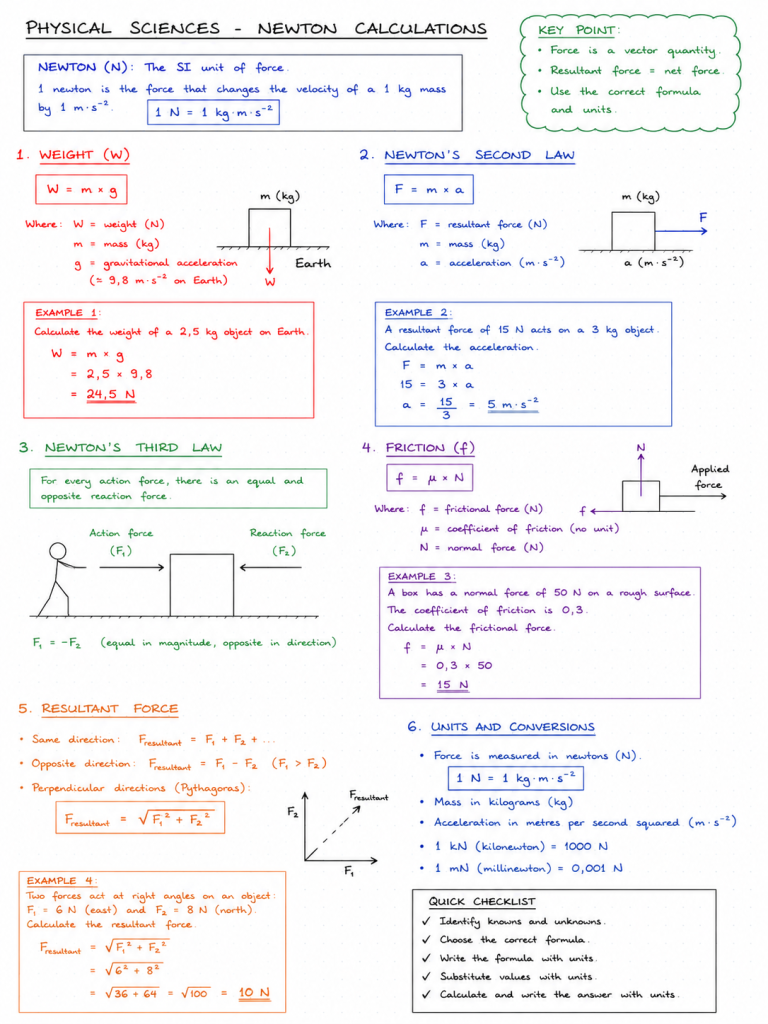
The answer to all these questions comes from Newton’s Laws of Motion.
In Natural Sciences and Physical Sciences, Newton’s Laws are some of the most important concepts learners study because they explain how forces and motion work in everyday life.
At preEminent Academy, we help learners understand Newton’s Laws using real-life examples instead of confusing memorisation.
Newton’s First Law: Objects Resist Change
Newton’s First Law explains that:
- an object at rest stays at rest,
- and an object in motion stays in motion,
unless a force acts on it.
This is why:
- a soccer ball eventually stops because of friction,
- and passengers move forward when a car brakes suddenly.
This law is often called the Law of Inertia.
Newton’s Second Law: Force Affects Motion
The Second Law explains that:
- bigger forces cause greater acceleration,
- while heavier objects need more force to move.
In simple terms:
- pushing an empty shopping trolley is easier than pushing a full one.
Learners often see this law in calculations involving:
- force,
- mass,
- and acceleration.
Understanding the relationship between these concepts is very important in Physical Sciences.
Newton’s Third Law: Every Action Has a Reaction
One of the most famous science principles is Newton’s Third Law:
“For every action, there is an equal and opposite reaction.”
This explains:
- why rockets launch upward,
- why swimmers push water backward to move forward,
- and why jumping off a small boat causes it to move backward.
Forces always work in pairs.
Why Learners Struggle With Newton’s Laws
Many learners memorise definitions without understanding how the laws apply in real life.
The key to mastering this topic is:
- using examples,
- drawing force diagrams,
- and practising problem-solving questions regularly.
Once learners connect the laws to everyday experiences, the topic becomes much easier to understand.
Why Newton’s Laws Matter
Newton’s Laws are not only important for school exams. They are also used in:
- engineering,
- sports science,
- aviation,
- vehicle design,
- and space exploration.
These laws help explain how movement works everywhere around us.
Final Thoughts
Newton’s Laws may seem difficult at first, but they become much easier when learners focus on understanding rather than memorising.
At preEminent Academy, we help learners break down scientific concepts step by step in a way that builds confidence and real understanding.
Because science is not just about passing exams. It is about understanding the world around you.