Cyberattacks are becoming more sophisticated every year, and organisations must secure every device connected to their networks. Laptops, desktops, smartphones, servers, tablets, and other connected devices known as endpoints are often the first targets for cybercriminals. Without proper endpoint security, a single vulnerable device can provide attackers with access to an entire network.
The Endpoint Security course from Cisco Networking Academy equips learners with the practical skills needed to identify vulnerabilities, secure operating systems, harden endpoints, and protect organisational data. This intermediate-level, self-paced course includes 27 hours of learning and 31 hands-on labs, giving students valuable real-world experience in modern cybersecurity practices.
At preEminent Academy, we proudly partner with Cisco Networking Academy to provide globally recognised technology training that prepares learners for careers in cybersecurity, networking, cloud computing, IT support, and information security.
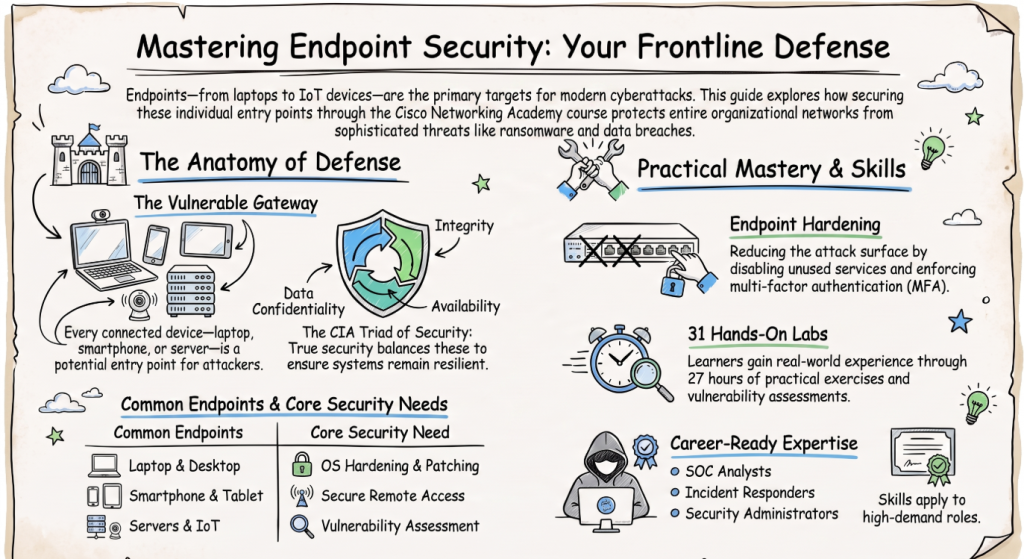
Table of Contents
What Is Endpoint Security?
Endpoint Security is the practice of protecting devices connected to a network from cyber threats. These devices include desktop computers, laptops, servers, smartphones, tablets, and other network-connected equipment.
Cybersecurity professionals use endpoint security solutions to prevent malware infections, ransomware attacks, unauthorised access, phishing attacks, and data breaches. They also monitor devices for suspicious activity while ensuring systems remain secure and compliant with organisational policies.
The Cisco Networking Academy Endpoint Security course teaches learners how to identify vulnerabilities, secure operating systems, protect sensitive data, and implement security best practices that reduce cyber risk.
Why Is Endpoint Security Important?
Modern organisations rely on thousands of connected devices every day. Every endpoint represents a potential entry point for attackers if it is not properly secured.
Learning Endpoint Security enables you to:
- Identify security vulnerabilities.
- Protect Windows and Linux operating systems.
- Secure network-connected devices.
- Prevent malware and ransomware attacks.
- Maintain data confidentiality.
- Preserve system integrity.
- Ensure high system availability.
- Apply endpoint hardening techniques.
- Reduce organisational cyber risk.
- Prepare for cybersecurity careers.
As remote work and cloud computing continue to grow, endpoint security has become one of the most critical areas of modern cybersecurity.
What Is an Endpoint?
An endpoint is any device that connects to a network. Common endpoints include:
- Desktop computers
- Laptops
- Servers
- Smartphones
- Tablets
- Virtual machines
- Point-of-sale systems
- IoT devices
- Printers
- Remote workstations
Each endpoint must be protected because attackers often exploit weak devices to gain access to larger organisational networks.
Learn more about endpoint security:
- Cisco Networking Academy: https://www.netacad.com/
- Cybersecurity & Infrastructure Security Agency (CISA): https://www.cisa.gov/
- National Institute of Standards and Technology (NIST): https://www.nist.gov/cyberframework
10 Essential Endpoint Security Skills You Will Learn
1. Vulnerability Assessment
Learn how to identify weaknesses within endpoints, operating systems, software, and networks before attackers can exploit them. Vulnerability assessments help organisations prioritise security improvements and reduce risk.
2. Network Security
Understand how secure network configurations, firewalls, segmentation, and monitoring protect connected devices from external and internal threats.
3. Operating System Security
Discover how to configure and secure operating systems by applying updates, managing user accounts, implementing security settings, and reducing unnecessary services.
4. Endpoint Hardening
Endpoint hardening involves reducing the attack surface of a device by disabling unnecessary features, applying patches, enforcing strong authentication, and following security best practices.
5. Data Integrity
Data integrity ensures information remains accurate, complete, and protected from unauthorised modification. You’ll learn techniques used to maintain trustworthy data across organisational systems.
6. Data Confidentiality
Protecting confidential information is essential for every organisation. This course explores authentication, encryption, access control, and security policies that prevent unauthorised users from accessing sensitive data.
7. Data Availability
Security is not only about preventing attacks—it also involves ensuring that authorised users can access systems and information whenever needed. You’ll learn strategies that improve system resilience and business continuity.
8. Malware Protection
Gain an understanding of malware, ransomware, spyware, viruses, and other malicious software while learning methods used to detect, prevent, and respond to infections.
9. Security Monitoring
Learn how organisations continuously monitor endpoints for suspicious behaviour using logging, endpoint detection tools, alerts, and security monitoring practices.
10. Hands-On Cybersecurity Labs
This course includes 31 practical labs, allowing learners to apply cybersecurity concepts through realistic exercises that reinforce endpoint protection techniques.
Vulnerability Assessment and Risk Management
One of the most valuable skills developed in this course is vulnerability assessment. Organisations regularly scan their systems to identify weaknesses before cybercriminals discover them.
Common vulnerability assessment activities include:
- Identifying outdated software
- Reviewing operating system configurations
- Detecting missing security patches
- Assessing user permissions
- Evaluating network exposure
- Prioritising security risks
Effective vulnerability management significantly reduces the likelihood of successful cyberattacks.
Learn more about vulnerability management:
- OWASP Foundation: https://owasp.org/
- CISA Known Exploited Vulnerabilities Catalog: https://www.cisa.gov/known-exploited-vulnerabilities-catalog
Securing Networks and Operating Systems
Protecting endpoints begins with properly securing the operating system and the network to which it connects.
The course introduces best practices for:
- Applying operating system updates
- Configuring secure user accounts
- Managing permissions
- Using antivirus and endpoint protection
- Configuring firewalls
- Monitoring network traffic
- Securing remote access
- Implementing strong authentication
These practices help reduce attack surfaces while improving the overall security posture of an organisation.
Endpoint Hardening Best Practices
Endpoint hardening is one of the most effective methods of preventing cyberattacks.
Best practices include:
- Keeping software updated.
- Enabling automatic security patches.
- Removing unnecessary applications.
- Disabling unused services.
- Using strong passwords and multi-factor authentication (MFA).
- Encrypting sensitive information.
- Applying least privilege principles.
- Monitoring endpoint activity.
- Performing regular security audits.
By following these practices, organisations reduce opportunities for attackers to exploit vulnerable systems.
Protecting Data Integrity, Confidentiality, and Availability
A fundamental principle of cybersecurity is the CIA Triad, which consists of:
Confidentiality
Ensuring only authorised individuals can access sensitive information through authentication, encryption, and access controls.
Integrity
Protecting information from unauthorised changes while ensuring data remains accurate and reliable.
Availability
Making sure systems, applications, and information remain accessible whenever authorised users require them.
Understanding these three principles helps cybersecurity professionals design secure and resilient environments.
Career Opportunities
Endpoint Security provides valuable knowledge for many cybersecurity and IT careers.
Potential career paths include:
- Cybersecurity Analyst
- Endpoint Security Analyst
- Security Operations Center (SOC) Analyst
- Information Security Analyst
- IT Security Administrator
- Network Security Technician
- Vulnerability Management Analyst
- Systems Administrator
- Cyber Defense Analyst
- Incident Response Analyst
This course also provides an excellent foundation for advanced Cisco cybersecurity learning pathways.
Why Study Endpoint Security with preEminent Academy?
At preEminent Academy, we partner with Cisco Networking Academy to deliver industry-recognised technology education that prepares learners for today’s digital workforce.
Our technology courses include:
- Cybersecurity
- Networking
- Linux
- Python Programming
- JavaScript
- Artificial Intelligence
- Data Science
- IT Support
- Cloud Computing
Through flexible online learning and expert guidance, you’ll gain practical skills that employers value across multiple technology industries.
Frequently Asked Questions
Is Endpoint Security suitable for beginners?
The Endpoint Security course is designed for intermediate learners who have a basic understanding of networking or cybersecurity concepts.
How long does the course take?
The course includes approximately 27 hours of self-paced online learning and 31 practical labs.
What skills will I develop?
You’ll learn vulnerability assessment, operating system security, endpoint hardening, network security, malware protection, confidentiality, integrity, availability, and risk management.
Why is endpoint security important?
Endpoints are common targets for cyberattacks. Proper endpoint protection reduces the risk of malware infections, ransomware, unauthorised access, and data breaches.
Does this course prepare me for cybersecurity careers?
Yes. Endpoint Security develops practical skills that are valuable for cybersecurity, IT support, network security, and information security roles.
Further Reading
Expand your cybersecurity knowledge with these trusted resources:
- Cisco Networking Academy – https://www.netacad.com/
- National Institute of Standards and Technology (NIST) – https://www.nist.gov/cyberframework
- Cybersecurity & Infrastructure Security Agency (CISA) – https://www.cisa.gov/
- OWASP Foundation – https://owasp.org/
- ISC2 – https://www.isc2.org/
- EC-Council – https://www.eccouncil.org/
Final Thoughts
Protecting endpoints has become one of the most important responsibilities in modern cybersecurity. As organisations continue to adopt cloud computing, hybrid work, and connected devices, skilled professionals who understand Endpoint Security, Vulnerability Assessment, Network Security, Operating System Security, Endpoint Hardening, and the principles of Confidentiality, Integrity, and Availability are in greater demand than ever.
The Endpoint Security course from Cisco Networking Academy provides practical knowledge, real-world labs, and industry-relevant skills that prepare learners for successful careers in cybersecurity and IT.
Start building your cybersecurity expertise today with preEminent Academy and gain globally recognised skills that help protect the digital world.
Learn with preEminent Academy
Ready to secure the future?
Join preEminent Academy and access world-class technology training through Cisco Networking Academy. Build practical, job-ready skills in cybersecurity, networking, IT support, Linux, cloud computing, programming, artificial intelligence, and data science.
Website: https://www.preeminent.co.za/
Explore Our Tech Courses: https://www.preeminent.co.za/tech-courses/
Follow us on Instagram: https://www.instagram.com/preeminent_academy/
https://www.preeminent.co.za/2026/07/30/cyber-threat-management-course/