Linux powers much of the technology we rely on every day, from the websites we visit and the cloud services we use to smartphones, supercomputers, and enterprise servers. Although many people interact with Linux without even realizing it, learning this operating system can open the door to exciting careers in IT support, cybersecurity, cloud computing, networking, software development, DevOps, and data engineering. If you’re looking to start a career in technology or simply want to understand one of the world’s most influential operating systems, this complete beginner’s guide will help you understand what Linux is, why it matters, and how you can start learning it today.
Many people assume Linux is only for programmers or experienced system administrators. In reality, Linux has become one of the most valuable skills for anyone entering the technology industry. Employers across South Africa and around the world are looking for professionals who understand Linux because it forms the backbone of modern computing infrastructure. Whether you’re interested in ethical hacking, cloud engineering, artificial intelligence, or technical support, Linux provides the foundation upon which many other technologies are built.
At preEminent Academy, we believe learning Linux is one of the smartest investments you can make in your technology career. Through our partnership with Cisco Networking Academy, learners can access industry-recognised Linux training designed to prepare them for real-world IT environments.
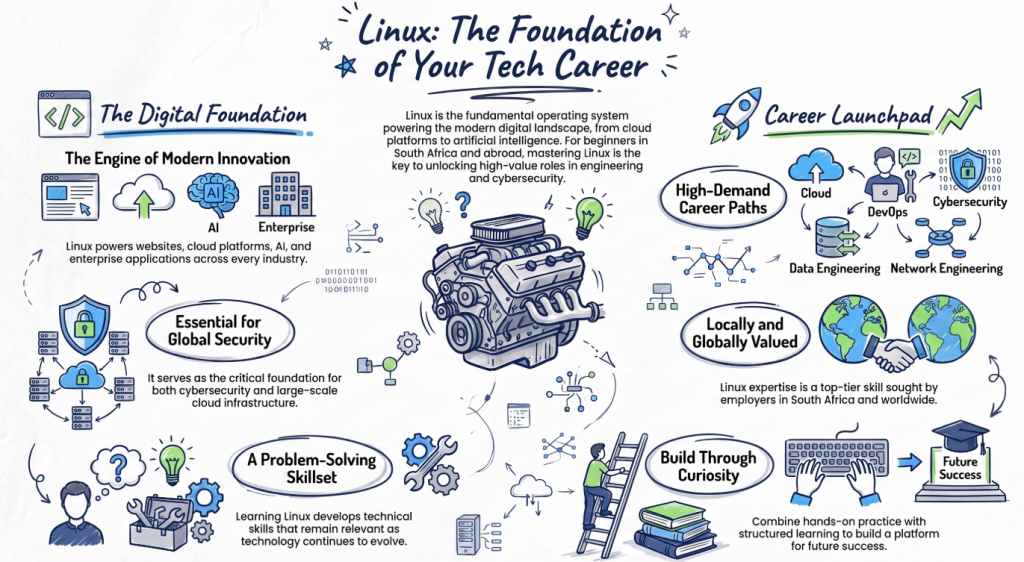
Table of Contents
What Is Linux?
Linux is an open-source operating system that allows computers to communicate with hardware, run applications, manage files, and perform countless other tasks. Just as Windows and macOS enable people to use desktop computers, Linux provides the software that allows millions of servers, embedded devices, cloud platforms, and enterprise systems to operate efficiently.
An operating system acts as the bridge between computer hardware and the software you use every day. Without an operating system, your computer would not know how to store files, launch programs, connect to the internet, or manage memory. Linux performs all these essential functions while giving users exceptional flexibility, security, and performance.
Unlike proprietary operating systems, Linux is open source. This means its source code is publicly available for developers to study, improve, and distribute. The Linux Foundation explains that this collaborative development model has enabled Linux to become one of the most successful open-source projects in history, powering everything from smartphones to the world’s fastest supercomputers.
Learn more about Linux from the Linux Foundation:
https://www.linuxfoundation.org
Why Is Linux So Important?
One of the biggest reasons Linux is so valuable is its widespread use across the technology industry. While many home users are familiar with Windows or macOS, Linux dominates behind the scenes. Most websites you visit every day run on Linux servers. Many cloud platforms rely on Linux to host applications, process transactions, and deliver services to millions of users simultaneously.
Companies such as Google, Amazon, Meta, Netflix, and countless financial institutions rely heavily on Linux because of its stability, reliability, and security. Even Android, the world’s most popular mobile operating system, is built on the Linux kernel.
As organisations continue adopting cloud computing, artificial intelligence, and automation, professionals with Linux skills are becoming increasingly valuable. Understanding Linux gives you a competitive advantage because it supports so many other technologies used in modern IT environments.
The History of Linux
Linux was created in 1991 by Finnish computer science student Linus Torvalds, who wanted to develop a free operating system that anyone could use and improve. What began as a personal project quickly attracted developers from around the world, who contributed new features, fixed bugs, and expanded its capabilities.
Over the past three decades, Linux has evolved into one of the most important pieces of software ever created. Today it powers cloud platforms, enterprise data centres, smartphones, routers, smart televisions, scientific research facilities, and some of the world’s fastest supercomputers.
The open-source philosophy behind Linux has encouraged innovation by allowing individuals and organisations to collaborate rather than compete over the core operating system.
You can read more about Linux history on the official Linux website:
How Linux Works
Although Linux may seem complicated at first, its core purpose is straightforward. It manages communication between hardware components such as processors, memory, storage devices, and network interfaces while allowing users to run applications safely and efficiently.
At the centre of Linux is the kernel, which controls how the operating system communicates with hardware. Surrounding the kernel are utilities, libraries, and applications that allow users to interact with the system. Together these components create a complete operating system capable of supporting everything from personal computers to enterprise cloud infrastructure.
One of Linux’s greatest strengths is its flexibility. Unlike many operating systems that limit how users interact with the system, Linux allows users to customise almost every aspect of their environment. This flexibility has made it the preferred operating system for developers, system administrators, cybersecurity professionals, and cloud engineers.
What Is a Linux Distribution?
Although people often refer to Linux as a single operating system, there are actually many different versions known as distributions or distros. Each distribution is built around the Linux kernel but includes different software packages, desktop environments, and management tools designed for specific purposes.
Ubuntu is one of the most popular distributions for beginners because of its user-friendly interface and extensive community support. Red Hat Enterprise Linux is widely used by large organisations requiring enterprise-grade support and security. Debian is known for its stability, while Fedora often introduces the latest Linux technologies before they appear in enterprise environments. Kali Linux is popular among cybersecurity professionals because it includes specialised security testing tools.
Choosing the right distribution depends on your goals, but beginners often find Ubuntu to be an excellent place to start.
The official Ubuntu website provides free downloads and beginner documentation:
Why Companies Choose Linux
Businesses choose Linux for several reasons, including reliability, security, scalability, and cost-effectiveness. Because Linux is open source, organisations can customise the operating system to suit their specific requirements without paying expensive licensing fees for every server they deploy.
Linux is also renowned for its stability. Many Linux servers operate continuously for months or even years without requiring a restart, making them ideal for businesses that depend on uninterrupted services. This reliability explains why Linux is widely used in banking, telecommunications, healthcare, government, and cloud computing.
Security is another major advantage. Linux benefits from continuous improvements contributed by thousands of developers worldwide, allowing vulnerabilities to be identified and addressed quickly.
Careers That Require Linux Skills
Linux has become a foundational skill across many technology careers. Employers frequently look for candidates who understand Linux because it supports such a wide variety of enterprise systems.
Professionals working in cybersecurity often use Linux to investigate security incidents, monitor networks, and perform vulnerability assessments. Cloud Engineers rely on Linux when deploying applications on Microsoft Azure, Amazon Web Services (AWS), and Google Cloud Platform. DevOps Engineers automate software deployments using Linux servers, while Data Engineers use Linux to manage large-scale data platforms.
Software Developers, Network Engineers, Systems Administrators, Artificial Intelligence Engineers, and IT Support Specialists also benefit significantly from Linux knowledge. As businesses continue moving towards cloud-based infrastructure, Linux expertise has become increasingly valuable across almost every area of information technology.
Can Beginners Learn Linux?
Many people worry that Linux is difficult to learn because it uses a command-line interface. While the command line may appear intimidating at first, most beginners become comfortable with it after regular practice. Like learning any new language, consistency is more important than prior experience.
Modern Linux distributions provide graphical desktop environments similar to Windows and macOS, allowing beginners to learn gradually while building confidence with terminal commands. The Linux community also offers thousands of free tutorials, forums, videos, and documentation that make learning easier than ever before.
With patience, curiosity, and regular hands-on practice, almost anyone can learn Linux regardless of their technical background.
Learning the Linux Command Line
The command line is one of Linux’s most powerful features because it allows users to interact directly with the operating system. Rather than clicking through menus, users type commands to navigate directories, manage files, configure networks, install software, and administer servers.
Although memorising commands may seem challenging initially, they quickly become second nature through daily use. Understanding the command line also improves troubleshooting skills and enables professionals to automate repetitive tasks using shell scripts.
Many employers specifically look for candidates who are comfortable working in terminal environments because servers often operate without graphical interfaces.
How Linux Supports Cloud Computing
Cloud computing has transformed how organisations build and manage technology infrastructure, and Linux sits at the centre of this transformation. Most virtual machines, containers, and cloud-hosted applications run on Linux because of its efficiency, flexibility, and reliability.
Whether you’re deploying applications on Microsoft Azure, AWS, or Google Cloud, understanding Linux significantly improves your ability to manage cloud resources. Many cloud certifications also assume learners have basic Linux knowledge before progressing to more advanced topics.
As cloud adoption continues to grow across South Africa, Linux remains one of the most valuable technical skills for aspiring cloud professionals.
Linux in Cybersecurity
Cybersecurity professionals rely heavily on Linux because it provides powerful tools for monitoring systems, analysing network traffic, testing vulnerabilities, and responding to security incidents. Many specialised cybersecurity distributions are built on Linux, allowing analysts to perform advanced security testing efficiently.
Understanding Linux also helps security professionals identify system vulnerabilities, manage permissions, analyse logs, and secure enterprise infrastructure. As cyber threats become increasingly sophisticated, Linux knowledge continues to be an essential skill for security careers.
Linux and Artificial Intelligence
Artificial Intelligence, Machine Learning, and Data Science platforms frequently operate on Linux servers because they provide excellent performance, scalability, and compatibility with modern development tools. Popular frameworks such as TensorFlow and PyTorch are commonly deployed on Linux environments.
Researchers, engineers, and developers building AI solutions often choose Linux because it offers greater flexibility and control when managing computational workloads. As AI adoption accelerates across industries, Linux continues to play an important role in supporting these technologies.
Is Linux Free?
One of Linux’s greatest advantages is that it is free to download, install, and use. Most Linux distributions can be installed without purchasing expensive licences, making Linux an attractive choice for individuals, educational institutions, startups, and large enterprises.
Although some commercial distributions offer paid support services, the operating system itself remains freely available under open-source licences. This has contributed significantly to Linux’s global popularity.
How to Start Learning Linux
The best way to learn Linux is through practical experience. Reading articles provides useful background knowledge, but real understanding comes from installing Linux, exploring the operating system, experimenting with commands, and solving real problems. Creating small personal projects, practising file management, configuring users, and learning basic networking commands will gradually build your confidence.
Online learning platforms, official documentation, and structured courses can accelerate your progress by providing guided exercises and hands-on laboratories. Consistent practice over time is far more valuable than trying to memorise every command at once.
Learn Linux with preEminent Academy
At preEminent Academy, we help aspiring technology professionals develop practical Linux skills through our partnership with Cisco Networking Academy. Our Linux courses combine theory with hands-on practice, enabling learners to build confidence using the command line, managing files, administering users, and understanding how Linux supports cloud computing, cybersecurity, networking, and DevOps.
Whether you’re preparing for your first IT job or expanding your existing technical skills, Linux provides a strong foundation for a successful technology career.
Follow us on Instagram:
https://www.instagram.com/preeminent_academy
Frequently Asked Questions
Is Linux difficult to learn?
Linux has a learning curve, particularly when using the command line, but beginners who practise consistently often find it easier than expected. Modern distributions such as Ubuntu provide user-friendly interfaces while allowing learners to gradually develop command-line skills.
Is Linux better than Windows?
Neither operating system is universally better. Windows is popular for desktop computing, while Linux excels in servers, cloud computing, cybersecurity, software development, and enterprise infrastructure. The best choice depends on your goals.
Can Linux help me get a job?
Yes. Linux is widely used across industries and is considered a valuable skill for careers in cybersecurity, cloud computing, networking, DevOps, software engineering, IT support, and data engineering.
Do I need programming experience before learning Linux?
No. Many people begin learning Linux without any programming background. As your confidence grows, you can gradually explore scripting and automation using Bash or Python.
Final Thoughts
Linux is much more than an operating system it is the foundation of the modern digital world. From powering websites and cloud platforms to supporting artificial intelligence, cybersecurity, and enterprise applications, Linux has become an essential technology that drives innovation across nearly every industry. For beginners, learning Linux opens the door to countless career opportunities while developing valuable technical problem-solving skills that remain relevant as technology continues to evolve.
Whether your ambition is to become a Cloud Engineer, Cybersecurity Analyst, DevOps Engineer, Software Developer, Network Engineer, or Data Engineer, mastering Linux will provide a strong platform for future success. By combining hands-on practice with structured learning and continuous curiosity, you’ll be building skills that employers value both in South Africa and around the world.