Euclidean Geometry is one of the most important topics in Grade 12 Mathematics. While many learners find it challenging at first, it is also one of the most rewarding sections of the curriculum because it develops logical thinking, problem-solving skills and mathematical reasoning. Success in Euclidean Geometry does not depend on memorising answers; it depends on understanding concepts, applying the correct theorems and constructing logical arguments.
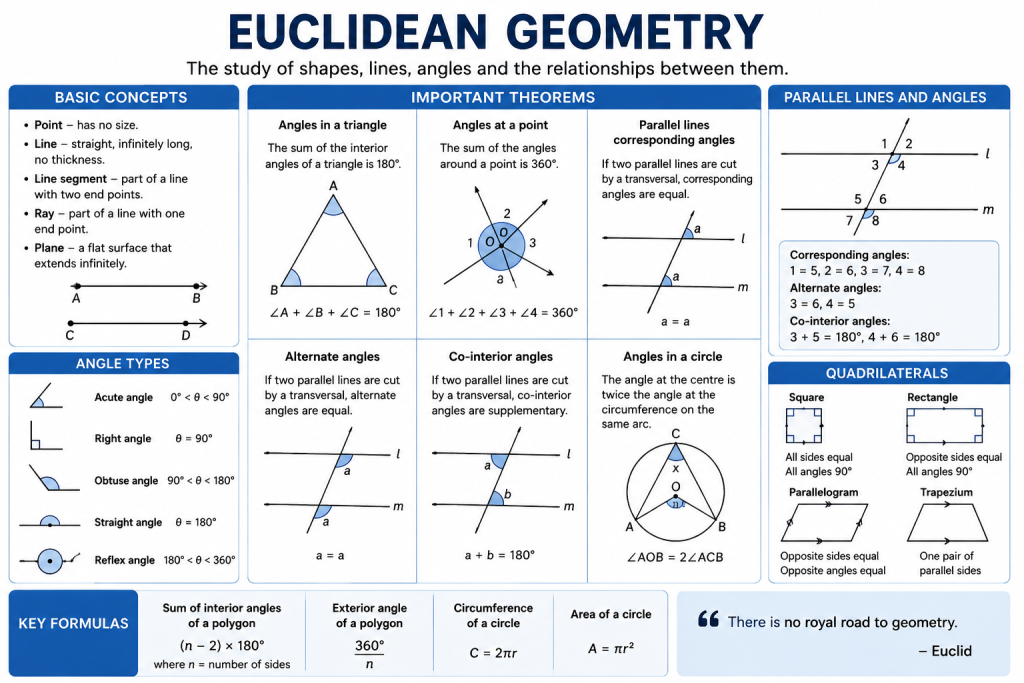
One of the reasons learners struggle with Euclidean Geometry is that it requires a different approach from other Mathematics topics. Unlike Algebra or Functions, where learners often follow a series of calculations, Geometry requires learners to analyse diagrams, identify relationships and justify every statement they make. This makes it a powerful tool for developing critical thinking skills that can be applied both inside and outside the classroom.
According to the Euclidean Geometry Printable Resources published by The Answer Series, learners should begin by developing a strong understanding of the terminology used throughout Geometry. Terms such as chord, diameter, tangent, cyclic quadrilateral and subtend appear frequently in examination questions and are essential for understanding geometric relationships. Without a solid grasp of these concepts, learners may find it difficult to apply the correct theorem when solving problems.
One of the most important sections of Euclidean Geometry is Circle Geometry. Learners are expected to understand how angles, chords, tangents and arcs interact within a circle. Theorems related to cyclic quadrilaterals, angles at the centre and angles subtended by the same chord often appear in Grade 12 examinations. These concepts form the foundation for many Geometry proofs and problem-solving questions.
Another key area is the study of Similar Triangles and Proportionality. Learners must be able to identify when triangles are similar and use proportional relationships to determine unknown lengths or angles. These skills not only assist with Geometry questions but also support learning in Trigonometry and other mathematical topics. Understanding the reasons behind similarity rules helps learners approach complex problems with greater confidence.
Geometric proofs are often considered the most challenging part of Euclidean Geometry. However, they become much easier when learners understand that every statement must be supported by a valid mathematical reason. Proofs are not about guessing answers; they are about building a logical argument step by step. This process teaches learners how to think critically and communicate mathematical ideas clearly.
A common mistake learners make is trying to memorise entire solutions instead of understanding the underlying principles. Examination questions are often presented in different formats, meaning learners who rely solely on memorisation may struggle when faced with unfamiliar diagrams. Learners who understand the theorems and relationships behind the questions are far more likely to adapt and succeed.
To improve performance in Euclidean Geometry, learners should practise regularly, revise theorem statements and work through past examination papers. Drawing and labelling diagrams carefully can also help learners identify important relationships more easily. Consistent practice builds familiarity with common question types and strengthens problem-solving skills over time.
At PreEminent Academy, we encourage learners to focus on understanding rather than memorisation. When learners understand why a theorem works and how it can be applied in different situations, they develop the confidence needed to tackle even the most challenging Geometry questions. With the right guidance, regular practice and a strong conceptual foundation, Euclidean Geometry can become one of the most rewarding sections of Grade 12 Mathematics.
Reference
The Answer Series. Euclidean Geometry Printable Resources. Available at: https://www.theanswer.co.za/wp-content/uploads/2023/06/Euclidean-Geometry-Printable-Resources-29.05.23.pdf