Grade 12 Accounting is one of the most important subjects for learners interested in business, finance, entrepreneurship, economics, or commerce-related careers. While many learners see Accounting as difficult because of calculations and financial statements, the subject is actually about understanding how businesses manage money and make financial decisions.
At preEminent Academy, we help learners understand that Accounting is not only about numbers. It is about logic, accuracy, analysis, and problem-solving.
The Accounting Equation Is the Foundation of Everything
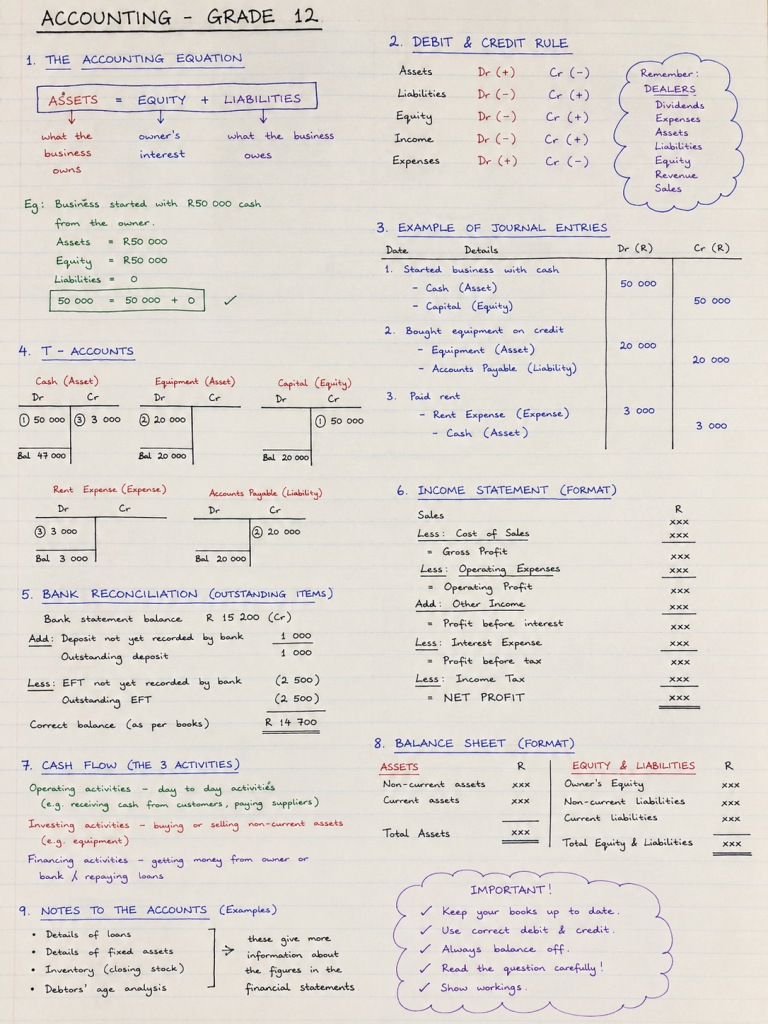
One of the first and most important concepts learners must master is the Accounting Equation:
Assets = Equity + Liabilities
This equation explains:
- what the business owns,
- the owner’s interest,
- and what the business owes.
Understanding this equation is extremely important because almost every section in Accounting connects back to it.
Many learners struggle later in the year because they do not fully understand how transactions affect the Accounting Equation from the beginning.
Debit and Credit Rules Confuse Many Learners
One of the most challenging areas for Grade 12 learners is understanding debits and credits.
Learners often panic when they see:
- Dr
- and Cr
in journal entries and ledger accounts.
However, once learners understand how different accounts behave, the topic becomes much easier.
For example:
- assets increase on the debit side,
- while liabilities and equity increase on the credit side.
The “DEALERS” rule is commonly used to help learners remember:
- Dividends,
- Expenses,
- Assets
increase on the debit side, while:
- Liabilities,
- Equity,
- Revenue,
- and Sales
increase on the credit side.
At preEminent Academy, we simplify debit and credit rules using practical examples and repeated exercises.
Journal Entries Build the Core of Accounting
Journal entries are another important section in Grade 12 Accounting.
Learners must record transactions accurately using:
- correct accounts,
- correct amounts,
- and correct debit and credit entries.
Examples include:
- starting a business with capital,
- buying equipment on credit,
- or paying expenses such as rent.
Journal entries may seem repetitive at first, but they form the foundation for:
- ledgers,
- trial balances,
- and financial statements.
T-Accounts Require Accuracy
T-Accounts are used to track movements in accounts such as:
- cash,
- equipment,
- capital,
- rent expenses,
- and accounts payable.
This section teaches learners:
- organisation,
- attention to detail,
- and balancing skills.
Small mistakes can affect the final answer, which is why neatness and careful calculations are very important.
Bank Reconciliation Is a Common Exam Topic
Bank reconciliation is one of the sections many learners fear because it involves identifying outstanding items and correcting balances.
Learners work with:
- outstanding deposits,
- EFT transactions,
- bank statement balances,
- and corrections.
The key to success in this section is careful reading and step-by-step calculations.
Many marks are lost simply because learners rush through the question.
Financial Statements Are Extremely Important
One of the biggest sections in Grade 12 Accounting is financial statements.
Learners prepare:
- Income Statements,
- Balance Sheets,
- and Cash Flow Statements.
The Income Statement helps determine:
- gross profit,
- operating profit,
- and net profit.
The Balance Sheet shows:
- assets,
- equity,
- and liabilities.
Learners must also understand how businesses manage:
- operating activities,
- investing activities,
- and financing activities.
This section requires both calculation skills and interpretation abilities.
Notes to the Accounts Matter Too
Many learners focus only on financial statements and ignore notes to the accounts.
However, notes provide important details about:
- loans,
- fixed assets,
- inventory,
- and debtors.
Understanding these notes helps learners interpret financial information more effectively.
Why Learners Struggle With Accounting
Grade 12 Accounting becomes difficult when learners:
- avoid practising regularly,
- memorise without understanding,
- or fall behind on corrections.
Accounting requires:
- consistency,
- logical thinking,
- and regular revision.
The more learners practise:
- journal entries,
- T-accounts,
- reconciliations,
- and financial statements,
the more confident they become.
Accounting Builds Real-Life Skills
Accounting teaches learners important skills such as:
- financial literacy,
- analytical thinking,
- organisation,
- problem-solving,
- and decision-making.
These skills are valuable in careers such as:
- accounting,
- banking,
- auditing,
- finance,
- entrepreneurship,
- and business management.
Final Thoughts
Grade 12 Accounting may seem challenging at first, but with proper understanding and consistent practice, learners can improve significantly.
The subject is not only about calculations. It is about understanding how businesses operate financially and making informed decisions.
At preEminent Academy, we help learners build confidence, master Accounting concepts, and prepare effectively for matric success through structured support and engaging learning.