When Grade 12 learners prepare for Life Sciences Paper 1, one topic almost always appears on the study list: the human eye.
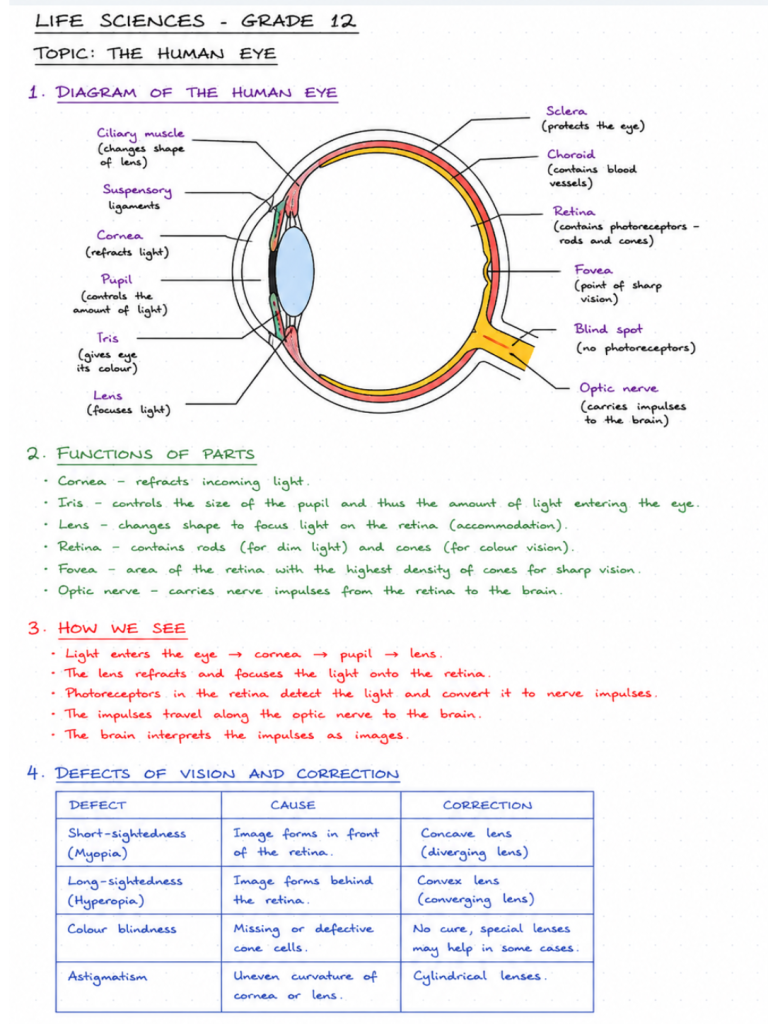
For many learners, the eye section feels difficult because it includes diagrams, labels, functions, vision defects, and complicated biological terms all at once. But once learners understand how the eye works step by step, the topic becomes far easier and much more interesting.
At preEminent Academy, we help learners simplify the eye section into understandable concepts instead of overwhelming notes.
Why the Eye Is So Important
The human eye is one of the key sections in:
- Human Nervous System,
- Sense Organs,
- and Homeostasis.
This means learners can expect:
- theory questions,
- diagram questions,
- definitions,
- functions,
- and application questions in exams.
The eye is also connected to practical understanding, which makes it a favourite topic in exams.
The Most Important Parts Learners Must Know
Grade 12 learners should understand the functions of:
- the cornea,
- retina,
- iris,
- pupil,
- lens,
- optic nerve,
- sclera,
- and ciliary muscles.
One common mistake learners make is memorising labels without understanding what each structure actually does.
For example:
- the iris controls the amount of light entering the eye,
- while the lens helps focus images on the retina.
Once learners understand the function of each part, answering exam questions becomes much easier.
Accommodation Confuses Many Learners
One of the most tested sections is accommodation.
This refers to how the eye changes focus when looking at objects that are near or far away.
Learners often struggle because they must explain:
- what happens to the ciliary muscles,
- suspensory ligaments,
- and lens shape.
The key is understanding the process step by step instead of trying to memorise long paragraphs.
Vision Defects Are Easy Marks
Another important section is visual defects such as:
- short-sightedness (myopia),
- long-sightedness (hyperopia),
- astigmatism,
- and cataracts.
Learners should know:
- the cause of each defect,
- how it affects vision,
- and which lenses correct it.
These questions are often straightforward when learners practise enough examples.
Diagrams Matter
Life Sciences Paper 1 frequently includes diagrams of the eye.
Learners must practise:
- labelling diagrams correctly,
- identifying structures,
- and interpreting information from images.
Small mistakes in spelling or labelling can cost marks, even when learners understand the content.
The Secret to Mastering the Eye Section
The best way to improve in this topic is through:
- repeated revision,
- diagram practice,
- active recall,
- and past exam questions.
At preEminent Academy, we encourage learners to explain the process aloud as if teaching someone else. This helps strengthen understanding and memory.
Final Thoughts
The human eye may seem like a difficult topic at first, but it becomes much easier once learners understand how the structures work together to produce vision.
With consistent practice and proper guidance, learners can turn this section into one of their strongest areas in Grade 12 Life Sciences.
At preEminent Academy, we help learners build confidence, improve understanding, and prepare effectively for Life Sciences Paper 1 success.